All-in-one wheel shop software: what it should actually cover
Most wheel shops accumulate software rather than choose it. Here are the five jobs a complete system has to do, and the ones you can safely ignore.
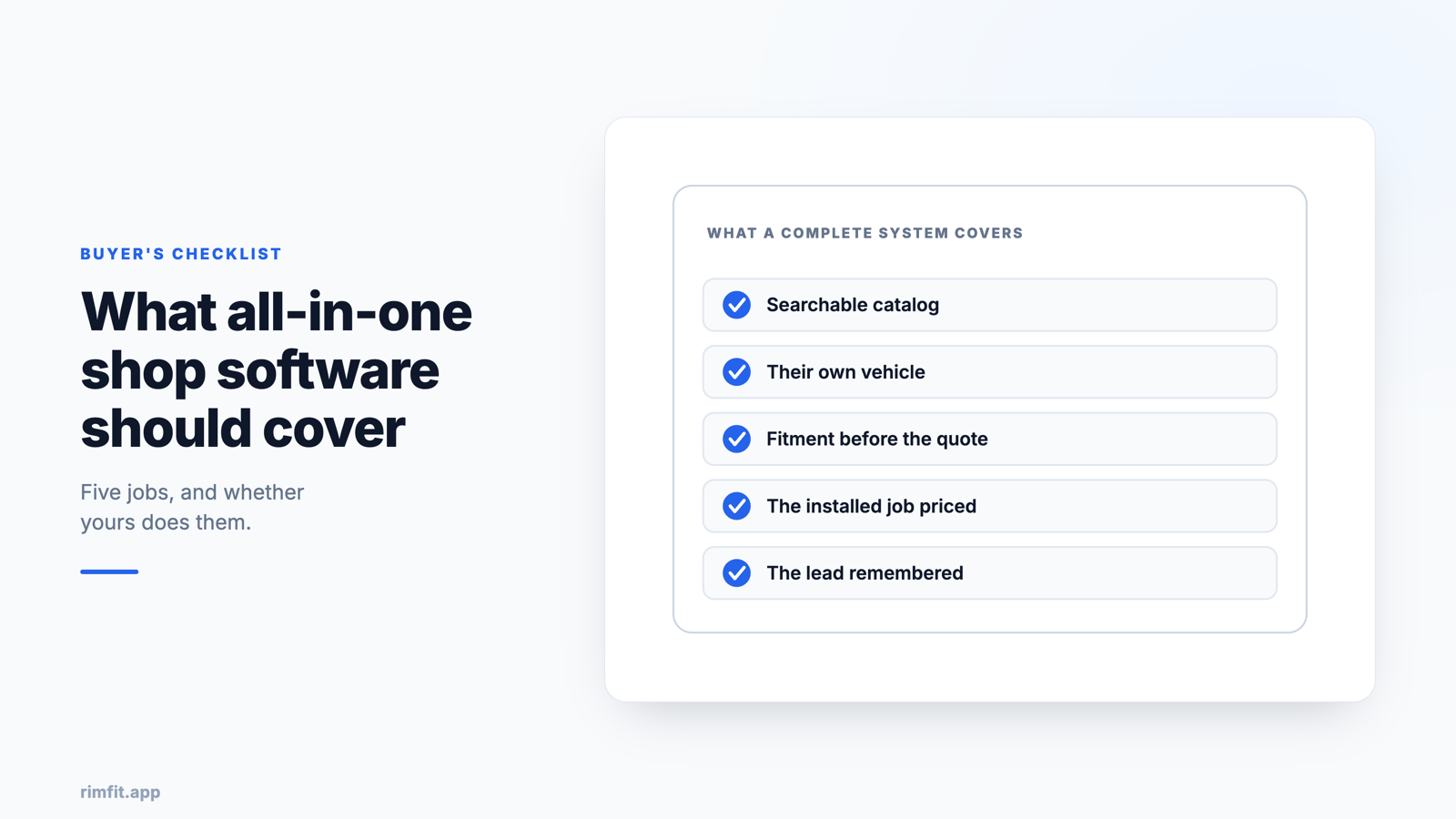
Most wheel shops don't buy software. They accumulate it. A catalog spreadsheet somebody started in 2019, a quoting template in Word, a notebook by the register with phone numbers in it, and the manufacturer's configurator open in a browser tab. None of it was chosen. It piled up.
You notice the gaps at the counter. A customer is standing there with his truck outside and you need four answers at once: what you can get, whether it fits, what it looks like on his vehicle, and what the whole job costs. When those answers live in four places, the time it takes to assemble them is time he spends deciding to think about it.
A catalog you can actually search
Current, searchable, with real specs attached. If you have to phone a supplier to find out what offset something is, your catalog isn't doing its job. Loading it shouldn't eat a week either. Better tools let you paste supplier links and pull the photos and specs across automatically, which is the difference between a catalog you maintain and one you abandon. We wrote about that in more detail in rim catalog software.
A way to show the customer
This is the job most shops have no tool for. A wheel on a stand tells him nothing about his own truck. A configurator on the manufacturer's site shows a wheel on a silver sedan in a studio. Putting that set on a photo of his actual vehicle is the version that ends the hesitation, because there's nothing left for him to imagine.
See it on your customer's actual car
RimFit turns a photo of the car + any set of rims into a photoreal preview in seconds. Built for tire & wheel shops.
RimFit for shops →Fitment checked before you quote, not after
Bolt pattern, offset, center bore and clearance, checked against that customer's vehicle while he's still at the counter. Finding out in the bay next week costs you the refund, the restocking, the return shipping and the hour your tech already spent mounting tires. See what a fitment check covers.
Quoting on the same screen
Wheels, tires, TPMS, mount and balance, as one number. A quote that lives in a separate document means the customer leaves holding a price with no picture attached to it, which is the least persuasive thing you can hand someone.
Something that remembers the customer
Plenty of wheel sales don't close on the first visit. If the only record of the conversation is a sticky note, the follow-up depends on somebody remembering. Every quote should become a lead with a status you can move, so you can see who's still open.
What you can skip
Shop software is often sold with scheduling, payroll, deep inventory and accounting integration. Buy those if you need them, but be clear that they aren't what loses you the wheel sale. The wheel sale is lost between "I like those" and "let me think about it," and nothing in a payroll module reaches that moment.
The test worth applying to any platform: can a salesperson do all five of those things without switching screens while somebody waits? That's a higher bar than most tools clear, and it's the one RimFit was built against.
Frequently asked questions
What should all-in-one wheel shop software include?
A searchable catalog with real specs, a way to show the wheels on the customer's own vehicle, a fitment check that runs before you quote, quoting for the whole installed job in one number, and a record of each quote as a lead you can follow up. Anything beyond that is useful but it isn't what decides the wheel sale.
Do I need separate software for my rim catalog and quoting?
You can run them separately, but it means retyping the same wheel into a quote after looking it up in a catalog, which is where transposed offsets come from. Keeping the catalog, the visual, the fitment check and the quote on one record removes the retyping.
Is wheel shop software worth it for a single location?
It depends on whether you sell custom wheels or mostly tires. If customers regularly ask what a set would look like on their vehicle, the visual and fitment side pays for itself quickly. If you're tire-only, most of it won't apply.
Show customers their car — before they buy
RimFit is the AI wheel visualizer built for tire & wheel shops.
RimFit for shops →