The five-tool problem: what a disconnected wheel shop stack costs you
Supplier site, spreadsheet, configurator, Word quote, somebody's memory. Five tools that don't know about each other, and the four costs that never show up as a line item.
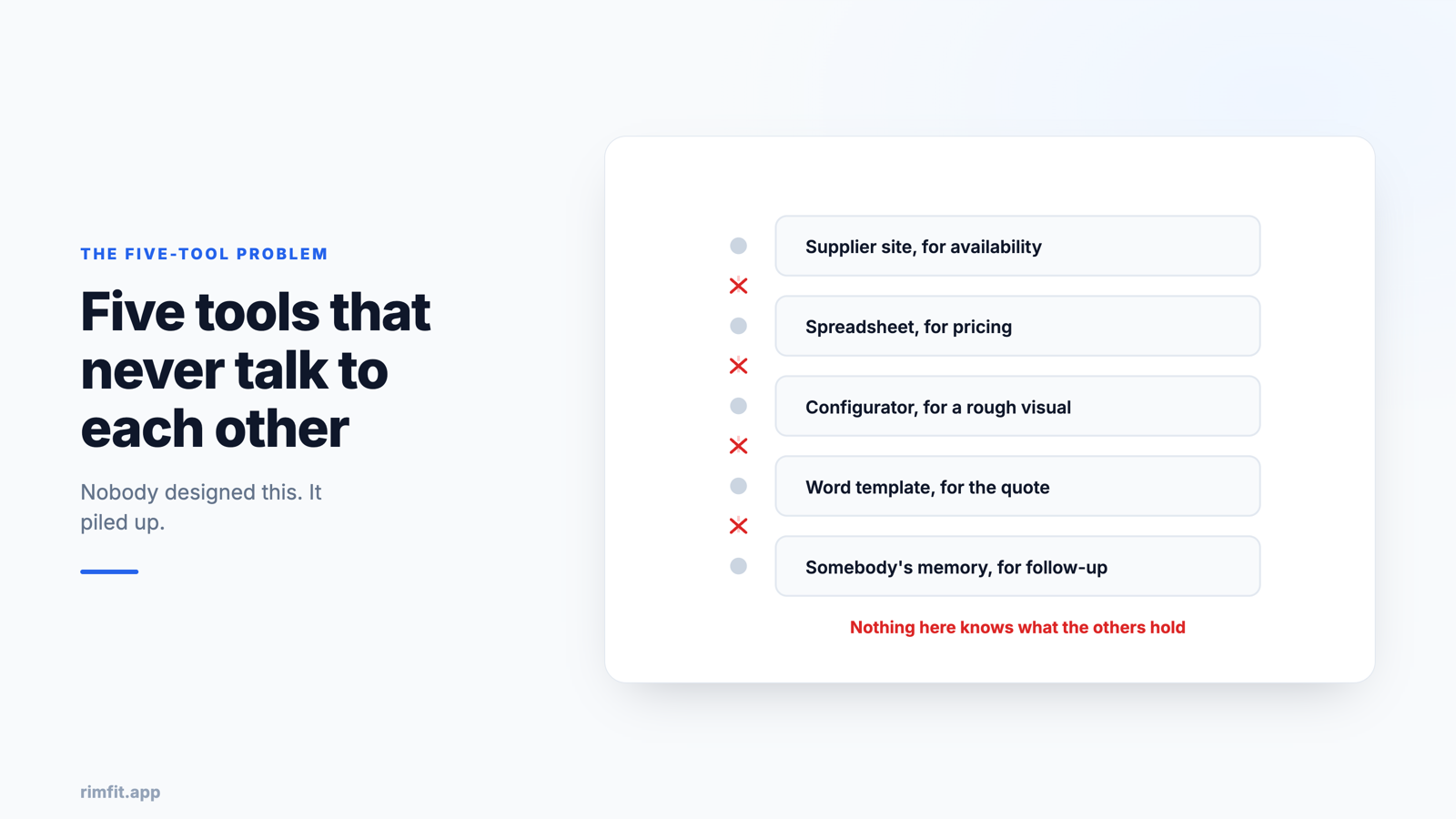
Count the places a single wheel sale touches at your shop. For most independents it runs something like this: the supplier site for availability, a spreadsheet or binder for pricing, a manufacturer configurator for a rough visual, a Word template for the quote, and somebody's memory for the follow-up. Five tools, none of which know about each other.
Nobody designed that. It's what you get from solving problems one at a time over several years. The cost is real and almost entirely invisible, because it never appears as a line item.
The pause at the counter
Every switch between tools is dead air while a customer waits. Half a minute hunting for a spec, a minute building a quote, another minute finding a photo of roughly the right vehicle. Each one is trivial on its own. Stacked together they're the difference between a customer who feels looked after and one who starts checking his phone.
Typing the same wheel three times
The same set gets looked up on a supplier site, written into a spreadsheet, then typed again into a quote. Every retype is a chance to transpose a digit, and an offset entered wrong is a wheel that comes back.
See it on your customer's actual car
RimFit turns a photo of the car + any set of rims into a photoreal preview in seconds. Built for tire & wheel shops.
RimFit for shops →Nothing remembers anything
A customer comes in on a Tuesday, likes a set, says he'll think about it. There's no record anywhere. No follow-up fires. Weeks later he buys elsewhere and you never find out it happened. This is the cost shops feel most and name least, because the sales you lose this way never announce themselves.
You can't see your own numbers
When quotes live in documents and leads live in heads, you can't answer a basic question like how many people you quoted last month and how many of them bought. Without that, stocking decisions and coaching are both guesswork.
What consolidation actually buys you
Fewer logins is the least interesting part. The useful change is that when the catalog, the visual, the fitment check, the quote and the lead are one record, the follow-up stops depending on memory and the numbers become something you can look at. The customer also sees a shop that has its act together, which is its own reason to buy from you rather than from a website.
You don't have to replace everything at once. Start where you lose people, which for a shop selling custom wheels is usually the gap between showing a wheel and asking for the order. We covered that specific moment in turning "let me think about it" into a signed quote.
Frequently asked questions
Why do wheel shops end up with so many separate tools?
Because each one solved a problem on the day it was added. The spreadsheet fixed pricing, the configurator fixed showing something, the Word template fixed quoting. None of them were chosen as part of a system, so none of them talk to each other.
What does disconnected shop software actually cost?
Four things that never appear on an invoice: dead time at the counter while you switch tools, errors from retyping the same specs, follow-ups that never happen because nothing recorded the conversation, and no visibility into your own quote-to-sale numbers.
Do I have to replace all my shop tools at once?
No, and it's usually a bad idea. Start with the part of the sale where customers walk, which for custom wheels is the moment between showing a set and asking for the order.
Show customers their car — before they buy
RimFit is the AI wheel visualizer built for tire & wheel shops.
RimFit for shops →